Capita plc
Financial, Insurance and Business Management Services

“
Q>TAR has been in place for over twenty five years and has been used as our time recording system for monitoring staff attendance, sickness and holidays.
The data captured has been instrumental in ensuring there has been sufficient oversight of the company's staff utilisation across its operation.
During this time, there have been minimal issues with the software in terms of reliability and ease of data access.
The hardware, as it has aged, has shown an expected level of reliability, with any fix on fail requirements dealt with efficiently under the annual maintenance agreement.
All in all, the use of
Q>TAR has continuously satisfied the needs of the company, and the service provided by
P & Q International has been very satisfactory.”
(
Tim Sill of
Capita plc)
Cadbury (Ireland)
(Manufacturer of Confectionery products)
“We employ approximately 1400 employees between two plants in Ireland.
We have been using
QTAR since 1987 and operate it in both these plants.
Our shift patterns are very variable.
The staff at
P&Q are always very helpful.”
(
Catherine Murphy of
Cadbury (Ireland))
Monarch Aircraft Engineering
(Aircraft servicing & repairs)

“We installed
QTAR in 1991.
It revolutionised our whole system of doing the payroll.
QTAR is reliable and flexible and
P&Q are always ready to help, they respond very fast.”
(
Pat Thomas of
Monarch Aircraft Engineering Ltd)
Goodyear Dunlop
(world's largest tyre manufacturer)

“At the Wolverhampton site, the rules for calculating employees' gross pay are incredibly complicated,
depending on a multitude of factors such as the type of work, when they are working compared with their normal shift,
the reason for the overtime or shift swap and even how dirty the work is!
So
QTAR has to be used to calculate the gross pay for each period of work.
The supervisors approve and record reasons for overtime, shift swaps and absences during the shift, directly into the system, which has streamlined the process enormously.”
(
Audrey Woolvin of
Goodyear Dunlop)
Caparo Precision Tubes
(Manufacturer of Steel tubing)

“We first installed
QTAR in 1991.
We have found
QTAR extremely flexible - it can do anything you require of it.
Day-to-day operations are simple.
It rarely goes wrong or gives us trouble.
The Support team is well-informed and comprehensive.
P & Q have kept their focus squarely on T & A - they simply have to be good at it.”
(
Bob Sharratt of
Caparo Tubing)
Crown Cork and Seal
(International packaging company)

“We've had
QTAR installed for quite a few years, and we find it to be a good program.
P&Q are very friendly and helpful.
If I have a problem or question they are always ready to assist me.”
(
Christine Wathan of
Crown Cork and Seal)
Unisys Insurance Services
(Administering Life Insurance schemes)

“We have been using
QTAR since 1991.
We have a flexitime system with complex flexible working time requirements.
It is largely self-administered (within the rules configured into the system) by the 1,500 employees.
A competing system was installed and then rejected, since it was unable to cope with our requirements.”
(
Julie Coldridge of
Abbey Life)
TMD Friction
(Manufacturer of Brake friction components)

“Our shift patterns are complex – 5-day, 7-day, morning, afternoon, nights and rotating,
and we also have people on fixed salaries.
QTAR handles these fine.
When we upgraded
QTAR just before Christmas, that went very smoothly.”
(
P. A. Rothwell of
TMD Friction)
Kraft Suchard
(Manufacturer of Chocolate and confectionery)

“We have a workforce of about 850 and have used
QTAR since 1992 to keep track of shift work,
contractor hours and salaried personnel for payroll.
We also rely on
QTAR in our costing processes,
to authorise overtime, book employee holidays,
report excessive unauthorised absences, etc.”
(
Martin Buckle of
Kraft Suchard)
LEONI Wiring Systems
(Manufacturer of Lucas brand electronic vehicle parts)

“We originally purchased
QTAR in 1990 purely for payroll management, with up to 3000 individuals on the system.
We found that using the system was simple, with a lot of standard reports included.
But when we realised how
QTAR could be expanded, we had extra ones written for reporting things like absenteeism in different ways that suited our requirements better.
P&Q staff give good support and are easy to talk to, even if you aren't very familiar with computers.”
(
Stella Pepper of
LEONI)
British American Tobacco
(Tobacco manufacturer)

“The
QTAR system has been in our factory since 1986 and has been very stable with few issues.
P&Q support has been reliable and efficient.
The application has outlived a number of HR system transitions, and migration of interfaces has not been problematic.
A number of custom modules have been designed to meet our special needs, including absence and overtime reporting.”
(
Hans Commandeur at
BAT)
MBM Produce
(Foodstuffs)

“We have been using the
QTAR system about 16 years.
It works well. It's hard to make set rules about this kind of factory.
Work patterns change often.
People work very variable hours.
Sometimes they make time up when they need to come in late.
I find it easy to go into the system and override it.
We upgraded a few years ago, and we found
P&Q very helpful.
They are happy to talk me through any problems I may come across.”
(
Jenny Hawkins of
MBM Produce:)
Dunlop Oil & Marine
(Manufacturer of Industrial hosing)

“Dunlop Oil & Marine has been using
QTAR since 1984.
We have had no trouble with the system in all that time.
Because
P&Q concentrate on T&A, the system works perfectly.”
(
Sue Thomas of
Dunlop Oil & Marine)
Some P&Q clients
(from UK, Ireland, New Zealand, Africa, etc)





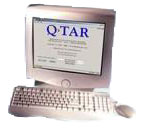 Conceived in 1984 as a configurable data collection system, Q›TAR was the world's first Time and Attendance Management package available for the then-new microcomputers.
Under continuous development since then, it is still today ahead of its time today.
The original system has grown into a family of related solutions, allowing businesses to access customised solutions for a similar price to other packages that cannot be adapted to your company's needs.
Conceived in 1984 as a configurable data collection system, Q›TAR was the world's first Time and Attendance Management package available for the then-new microcomputers.
Under continuous development since then, it is still today ahead of its time today.
The original system has grown into a family of related solutions, allowing businesses to access customised solutions for a similar price to other packages that cannot be adapted to your company's needs.

